
Benefits of Outdoor Play for Primary School Children
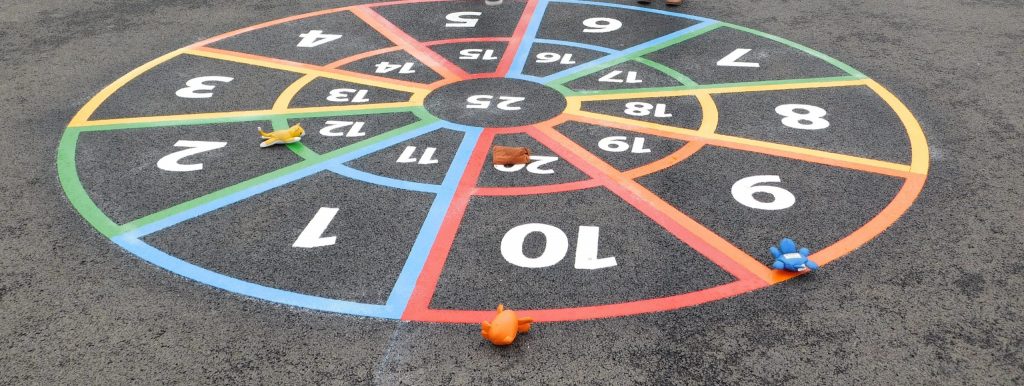
The benefits of outdoor play for primary school children include better physical health, stronger friendships and social skills, learning that carries on beyond the classroom, growing self-awareness and independence, and more creativity and confidence. A well-designed playground is where most children get these benefits every school day.
As designers and installers of playground markings for schools across the UK, we see how much difference the playground makes to how children play. Below we explain each benefit, why breaktime play reaches children that PE lessons sometimes miss, and how schools can get more from their outdoor space.
What are the main benefits of outdoor play for primary school children?
The main benefits of outdoor play for primary school children are physical health, social skills, wider learning, emotional wellbeing, independence, creativity and resilience, and each one grows when pupils have an inviting outdoor space with plenty to do.
Better physical health and movement skills
Regular outdoor play helps children reach the right level of activity for their age. Running, jumping, hopping and skipping build muscle, strength, coordination, balance and spatial awareness, and they develop fundamental movement skills such as stability and object control. These early habits lay the foundations for an active lifestyle later on and help counter the sedentary routines many children now have.
Stronger friendships and social skills
Outdoor play usually happens in groups, so it shapes peer relationships. On the playground children learn to share, take turns, negotiate, resolve conflicts and play in both large and small groups. Structured games such as hopscotch, mazes, target games and number grids give them a reason to cooperate and communicate, and they help quieter or more introverted children build routines and friendships.
Learning beyond the classroom
Outdoor play lets children take their learning outside. Number grids help with counting, alphabet markings help with letter recognition and spelling, and mazes and puzzle games stretch problem-solving and decision-making. When resources are there, children see that they can keep building their knowledge away from the classroom.
Emotional wellbeing and self-awareness
Outdoor play helps children understand their own feelings and emotions and develop observation and reasoning skills. An inviting, colourful space can reduce stress and anxiety, and breaktime gives children a chance to decompress before going back to lessons. Our guide on how outdoor play supports children's mental health covers this in more detail.
Independence and confidence
Learning to play without an adult directing them is the start of a child's independence. On the playground children choose their own games, invent rules and use whatever resources are around them, which builds self-confidence and decision-making.
Creativity and imagination
Markings that look like roads, rivers, cities, pirate islands or space scenes turn the playground into a setting for imaginative play. Children step into roles as explorers, pirates or adventurers, make up their own stories and invent new games, which builds language and creative thinking.
Resilience and safe risk-taking
Outdoor play gives children manageable challenges. Obstacle-style designs and trails ask them to work out a route and push their own limits in a safe, supervised setting, which builds resilience, confidence and problem-solving.
How does outdoor play help primary school children get enough physical activity?
Outdoor play helps primary school children get enough physical activity by adding movement to every breaktime and lunchtime, which matters because PE lessons alone rarely get pupils near the recommended hour of activity a day.
Moderate to vigorous physical activity (MVPA), the kind that makes children breathe harder, plays an important part in children's long-term health. Research by Liverpool John Moores University into the Sporting Playgrounds project looked at how changing the playground affects activity, and identified playground markings as a key way to increase it. The researchers linked even 5 extra minutes of MVPA a day with a lower long-term risk of cardiovascular disease, and found that the increase in activity after a playground redesign was still there 12 months later.
Programmes such as The Daily Mile build on the same idea. A marked mile track lets pupils walk, jog or run a set distance at their own pace, and our Daily Mile track markings show them how far they have gone so they can set themselves goals.
Why does outdoor play get some children moving when PE lessons do not?
Outdoor play gets some children moving when PE lessons do not because it lets them choose the game, choose who they play with, join in informally without pressure and do it every day, rather than only when PE is timetabled.
- They choose the game. Football, netball and rugby are popular, but they do not motivate every child. A playground with a range of courts, trails and games gives children the freedom to find something they actually enjoy, which is more likely to grow into a lasting interest.
- They choose who to play with. Teams in PE are often picked for them, which some children find intimidating. Playing similar games with friends at breaktime builds their skills and confidence, so they are more willing to take part in lessons.
- It is informal and less competitive. Children can drop in and out of playground games without worrying about doing it wrong or letting the team down, and develop at their own pace.
- They can play every day. PE is not a daily lesson for many pupils, but breaktime is. Daily play adds up even if it does not cover the full hour on its own.
How do playground markings increase the benefits of outdoor play?
Playground markings increase the benefits of outdoor play by turning a plain tarmac surface into a set of games, trails and learning activities that children use on their own, which gives every pupil more reasons to move, mix and learn outside.
Traditional games such as hopscotch and snakes and ladders, adventure trails, mazes, target games and life-sized board games all get children moving. Number grids, letter grids and world maps blend learning into play. Areas of the playground can be zoned by theme or key stage, with active zones, quieter spaces and courts for older pupils, so younger and older children each have space that suits them.
Markings also make the playground more inclusive. Sensory paths and tactile games suit children with special educational needs, and our sensory and SEND playground markings are designed so every child feels welcome and engaged. Thermoplastic markings are slip-resistant, which helps reduce slips during running games.
How can primary schools pay for playground improvements that support outdoor play?
Primary schools in England can often use their PE and Sport Premium funding towards playground markings that increase physical activity, as the funding is there to help schools improve PE, sport and activity for their pupils.
Many schools combine this with fundraising or other budgets and build up their playground in stages. Our markings start from around £50 for a single design (indicative, excluding VAT), so even a small first phase can make a difference, and we can plan a layout that leaves room to add more later.
Which playground markings do we install to support outdoor play?
Our team designs and installs thermoplastic playground markings for primary schools across the UK, including mile tracks, number grids, traditional games, sports courts, roadways, board games and educational markings, all chosen to keep pupils engaged in outdoor play.
- Mile tracks and active trails
- Number grids and letter games
- Traditional playground games such as hopscotch and snakes and ladders
- Sports court markings, plus long jump, skipping, hopping and jumping spots
- Roadways for imaginative play and road safety
- Educational and life-sized board game markings
Our design team also creates bespoke playground markings, including designs that use your school logo and colours, and we are happy to involve pupils in the design stage. Our markings carry a manufacturer's warranty of up to 4 years, subject to ground condition, we have seen them last over 10 years, and they are ready to use within 30 minutes of installation.
If you are planning your next playground project, large or small, call our team on 0333 321 6699 or email [email protected] and we will be in touch as soon as possible.
Ready to transform your playground?
A free design and a detailed quote, with no hidden costs and our price match promise.
All prices include installation, and every quote is fully itemised.
- Free design and site survey
- No obligation
- Our own in-house installation team
More from the blog
Benefits of Playground Markings for Schools and Pupils
Playground markings give schools more active break times, better PE, stronger social skills, calmer playtimes and learning that carries on outside.
Choosing the right playground games for KS2
Some examples of popular playground games for KS2 include:
Creative Playground Markings Ideas for Schools
Explore innovative playground markings ideas that blend fun and learning. Discover how Uniplay designs inspire maths, strategy, and inclusive play.